

The Challenge
Create the vision
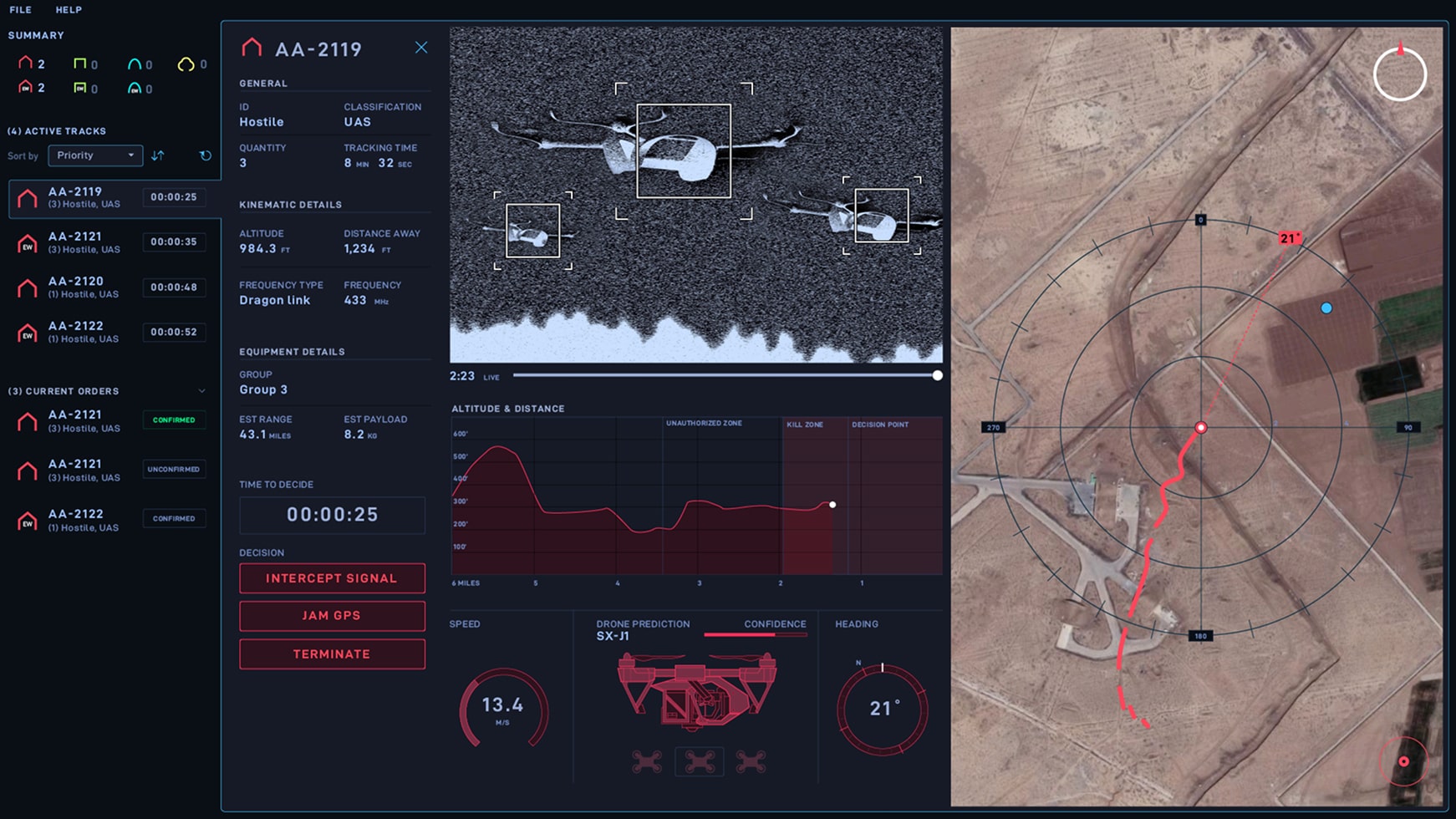
In the effort to win a contract, we wanted to demonstrate our domain expertise to the prospective client. We took a risk by going out on a limb and presenting a redesign of their legacy counter-UAS command and control (C2) system.
Why was this a risk? They didn’t ask us to do this. But we believe the power of “giving away the business”: The best way to attain buy-in to the power of Human-Centered Design is to show it in action.

The Work
Here’s how we tackled the challenge
We had just two weeks to research and design a concept that could demonstrate our ability to work within complex knowledge spaces. Using the information available to us and drawing from our existing domain knowledge, we set out to:
Increase speed of threat ID, characterization, and decision time
Decrease threat engagement time
Strengthen knowledge of outcome
Here are some of the main ways we fulfilled those goals:
Established a new, left-to-right information hierarchy that:
Aligned with users’ mental models
Prioritized threats in a way that minimized distraction
Used contextual disclosure of information dependent on the user’s area of focus
Used a modern, familiar map view for big-picture situational awareness
Designed new, enhanced data visualizations including a live timeline, heading and speed visualizations to help make rapid decisions
Employed an intentional, minimal color palette to minimize distraction and draw focus to where it matters

Working from limited visibility
We didn’t have firsthand access to legacy system we were redesigning. This meant that our viewpoint was constrained to a limited set of screenshots that were provided to us by the client.
Equipped with a deep history of domain knowledge and design expertise, it was up to us to learn the problem space, deeply analyze the system’s architecture from just a handful of screenshots, and then reverse engineer a new information architecture based on our observations.
“The work executed by Visual Logic completely exceeded requirements for the project and pleased project stakeholders with the thoroughness of their review and quality of their recommendations. Their team is on time and budget in all of their work.”
Read full review Maria Ucchino Former Director of Business Development, SRC
The Impact
Stakeholders were blown away
This calculated risk paid off—the vision we presented gave stakeholders something tangible to engage with and rally around. In a sense, we discovered the Northstar even before a contract was signed, helping SRC see the full potential of their initiative and the possibilities ahead.
It also laid the foundation for a lasting partnership between Visual Logic and SRC, setting the tone for all future projects. To learn more about our continued work with SRC, check out how we helped shape their design culture over a period of five years, or how we built them a mission-ready design system.
Whether you’re pitching to a customer or the board, we’ve proved time and again that ‘outside the box’ thinking isn’t just gold platting—it’s mechanism for generating excitement and buy-in.


